The Complex Trauma Training Center presents:

NARM® Therapist Training
Online Spring 2027


with Brad Kammer, LMFT, LPCC

Stefanie Klein, LCSW 

& Lisa Gillispie, LPCC-S

Experience the transformative power of the NARM® Therapist Training!


Join us for an advanced clinical training in the NeuroAffective Relational Model® designed exclusively for licensed mental health professionals, where you will:


Learn how to heal the impact of adverse childhood experiences (ACEs) and complex trauma (C-PTSD) with confidence, depth, and heartfulness.


Gain specialized trauma-informed training that supports the resolution of attachment, developmental, relational, cultural, and intergenerational trauma.


Integrate a neurobiologically-informed clinical approach that promotes post-traumatic growth.


Join a community where mindfulness meets clinical expertise.


Embody professional and personal growth.


Join us and become a catalyst for transformation in your practice and community.


Admission Requirements:


The NARM® Therapist Training is an advanced clinical training for the healing of complex trauma. Enrollment is open to licensed psychotherapists, counselors, social workers & other licensed mental health professionals who work with complex trauma. Graduate trainees and interns working toward licensure are welcome to apply. This clinical training is not appropriate for those solely seeking a personal growth experience.

Training Schedule

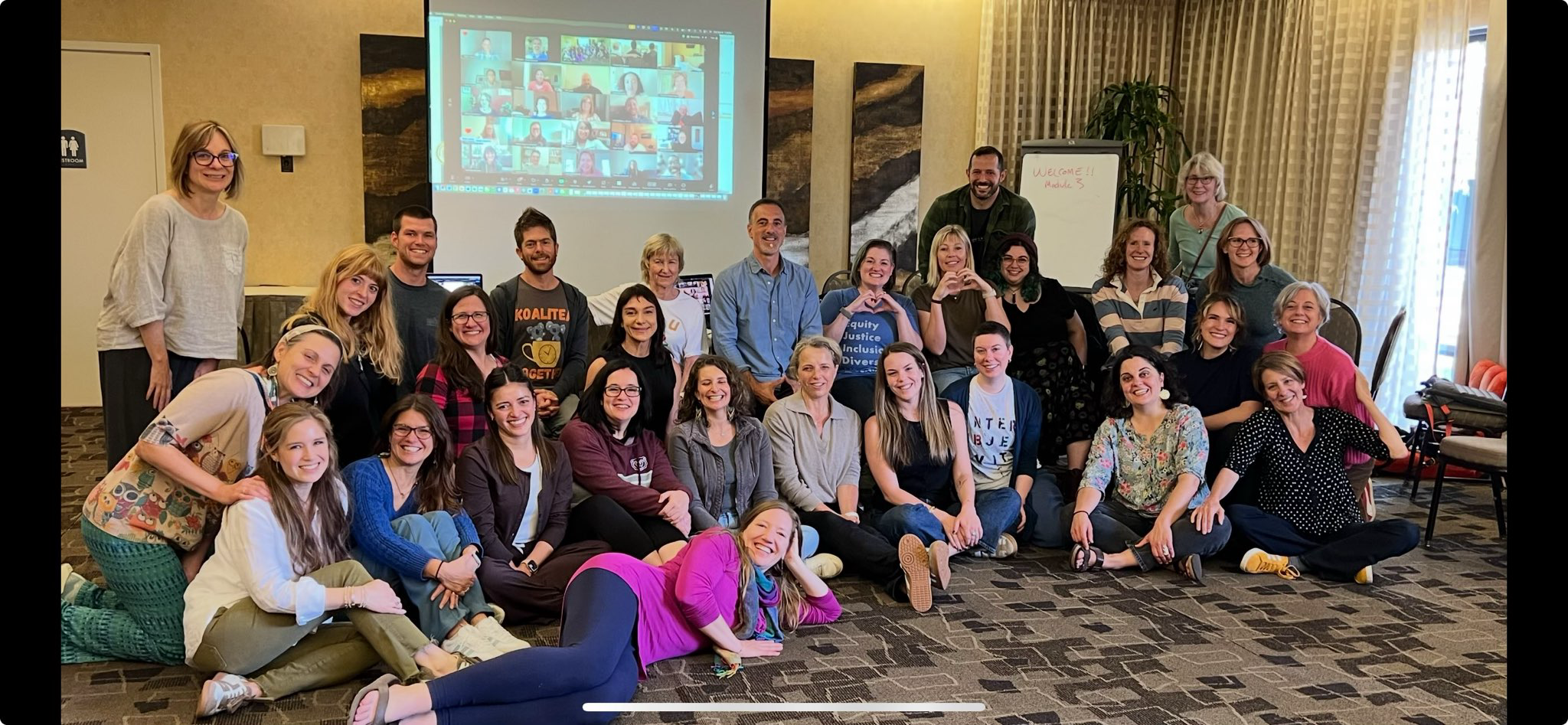
The NARM® Therapist Training Spring 2027 is being held online through Zoom. 

Module 1: Thursday, January 21, 2027 – Sunday, January 24, 2027
Module 1 Training Day: Friday, February 5, 2027


Module 2: Thursday, March 18, 2027 – Sunday, March 21, 2027
Module 2 Training Day: Friday, April 9, 2027


Module 3: Thursday, May 13, 2027 – Sunday, May 16, 2027
Module 3 Training Day: Friday, June 18, 2027


Module 4: Wednesday, August 11, 2027 – Sunday, August 15, 2027


Times:
8:00 am – 3:30 pm Pacific Time each day

Each morning and afternoon training session contains one 15-minute break. There is a one-hour lunch scheduled for each training day.


Please note this training is set for North America Pacific Time. Due to the experiential focus in learning and applying NARM®, we require full, live participation in the NARM® Therapist Training. If the time difference will make your full, live participation difficult, we advise you not to sign up for this training. Additionally, the training will be taught in English. Please note that no special accommodations can be made.  If you are able to commit to participating fully, we welcome your registration to this training regardless of your time zone. 

Training Curriculum

Module 1

Includes:

  • NARM Organizing Principles
  • NARM Theoretical Orientation 
  • Identifying & Addressing Adverse Childhood Experiences (ACEs) and Complex Trauma (C-PTSD)
  • Differentiating Interventions for working with Shock vs. Developmental Trauma
  • Working Top-Down and Bottom-Up
  • Tracking Connection & Disconnection
  • Developmental Process: Attachment & Separation-Individuation
  • Reframing Attachment and Attachment Loss
  • The Distortion of the Life Force Model
  • Distress and Healing Cycles
  • 5 Adaptive Survival Styles
  • Connection Survival Style
  • Attunement Survival Style
  • NARM 4 Pillars: Clinical Model
  • NARM Pillar 1: Establishing a Therapeutic “Contract”
  • NARM Pillar 2: Asking Exploratory Questions

Module 2

Includes:

  • The NARM Relational Model
  • Working Hypothesis
  • Identifying Core Dilemma: Core Themes vs Survival Strategies (Behaviors, symptoms, etc.)
  • Trust Survival Style
  • Autonomy Survival Style
  • Love-Sexuality Survival Style
  • NARM Pillar 3: Supporting Agency (Agency as the Foundation for the Development of the Adult Self)
  • NARM Pillar 4: Reflecting Positive Shifts
  • NARM Languaging

Module 3

​Includes:

  • NARM Emotional Completion Model
  • Primary vs Default Emotions
  • The Psychobiological Process of Shame
  • Shame, Guilt & Self-Hatred
  • Working with Anger & Aggression
  • Working with Grief & Sadness
  • Countertransference in NARM
  • Unmanaged Empathy and Therapist Efforting
  • NARM Personality Spectrum
  • 10 Psychobiological Traits of Health, Resilience and Wellness

Module 4

Includes:

  • Deepening Study into the Connection Survival Style Issues, Symptoms and Related Disorders
  • Revisiting the Dynamics of Attachment, Separation-Individuation, Attachment Loss and the Core Dilemma
  • Relationships, Couples, Intimacy and Sexuality
  • Survival Styles & the Polyvagal Theory
  • NARM & the Body
  • Working with Identity
  • Cultural Trauma
  • Intergenerational Trauma
  • Disidentification Process
  • “Cutting the Cord”: Freedom from Identity
  • Post-Traumatic Growth
  • Resiliency: Supporting the Capacity to Tolerate Increasing Psychobiological Capacity
  • Integrating NARM Effectively Into Our Clinical Practice

Training Pricing and Payment Plans

Email admin@complextraumatrainingcenter.com to inquire about special pricing for groups of 3+ from the same Clinic/Agency.

For participants who come from and/or work with underserved communities, learn more about our scholarship opportunities.

STANDARD RATE


$250 Application Fee

+

$1,350

per Module


Register Now!

STUDENT/INTERN RATE


$250 Application Fee

+

$1,050

per Module


Register Now!

COURSE INFORMATION

Course Description

THE NARM® THERAPIST TRAINING COURSE DESCRIPTION:


The NARM Therapist Training is an advanced clinical training in the NeuroAffective Relational Model® for licensed mental health professionals who work with the impact of adverse childhood experiences (ACEs) and complex trauma (C-PTSD). NARM addresses attachment, developmental, relational, cultural and intergenerational trauma by working with the psychobiological patterns of disconnection that deeply affect our identity, emotions, physiology, behavior and relationships. Integrating a psychodynamic and body centered approach, NARM offers a comprehensive theoretical and clinical model for working with complex trauma.


NARM draws upon multiple frameworks including psychodynamic modalities such as attachment and object relations theory, body-mind approaches, mindfulness-based models, and interpersonal therapies, in addressing the link between psychological issues, and the body. Working in the present moment, within a context of interpersonal neurobiology, NARM offers a powerful approach for working relationally that is a resource-oriented, non-regressive, non-cathartic, and ultimately non-pathologizing. Grounded in mindfulness and contemplative spiritual practices, NARM supports a non-western orientation to the nature of personality. Learning how to work simultaneously with these diverse elements is a radical shift that has profound clinical implications for healing complex trauma and supporting personal and relational growth.

Course Objectives

In the NARM Therapist Training you will learn:

  • The different skills needed to work with developmental versus shock trauma; when and why shock trauma interventions may be contraindicated in working with developmental trauma.
  • How to address the complex interplay between nervous system dysregulation and identity distortions, such as toxic shame and guilt, low self-esteem, chronic self-judgment, and other psychobiological symptoms.
  • How to work moment-by-moment with early adaptive survival styles that, while once life-saving, distort clients’ current life experience.
  • When to work ‘bottom-up’, when to work ‘top-down’, and how to work with both simultaneously to meet the special challenges of developmental trauma.
  • How to support clients with a mindful and progressive process of disidentification from identity distortions.
  • A new, coherent theory for working with affect and emotions, which aims to support their psychobiological completion.

Course Structure

The NARM Therapist Training consists of 120 contact hours and is offered in four 5-day live modules (format may vary depending on training location). The live modules will be held for a total of 20 days over the period of the training. The weekend training modules are typically spaced 3-4 months apart, with a 1-day integration day between Modules 1 and 2, 2 and 3, and 3 and 4, which allows ample time for continued study, practice, peer meetings, and training webinars in support of greater integration of the NARM clinical approach.


Supplemental learning opportunities include: individual and group case consultation, large and small group active coaching, experiential consults, demonstration groups, study and practice groups, and other learning intensives.

NARM® Therapist Certificate Information

Requirements to obtain your certificate can be found at the link below. The NARM® Therapist or NARM® Practitioner Certificate title will be designated based on your licensure status. NOTE: The NARM Therapist Training is not a licensure or certification training. You will be issued a training certificate upon completion of all requirements, NOT a certification. 


Click HERE for the Certificate Requirements

Teaching Methods

All modules include a combination of 2 complementary instruction approaches:

  • Didactic and theoretical learning: including lecture, question and answer periods, class-wide discussion, case consultation, and deconstruction of live NARM demonstration sessions and demonstration videos.
    • Please note that this training presents highly advanced psychological learning that involves complex, often evocative and transformative material on trauma.
  • Experiential learning: including self-inquiry exercises, small group activities, role-plays, guided skill practice and active coaching on NARM clinical skills and full clinical sessions.
    • Please note that this training presents an opportunity for clinical development based on direct personal experience that involves complex, often evocative and transformative material on trauma.

Training Orientation

We appreciate that so many mental health professionals work from a spirit of social justice and advocacy.  At the Complex Trauma Training Center, we are grounded in a strong commitment to addressing healing complex trauma as a vehicle for both personal and social transformation.  This also includes a strong commitment to promoting accessibility by creating a learning environment that supports diversity, fosters inclusion, and holds the intention to support connection and learning from each other.


We also want to be transparent with the intention for this NARM Therapist Training so all prospective training participants know what this training will provide and what it will not provide.  The NARM Therapist Training is an advanced psychotherapeutic training and will provide a comprehensive clinical training on the NeuroAffective Relational Model.  This training is not focused on social or political activism and will not provide specific training in addressing the systemic failures that perpetuate complex trauma.  While we do acknowledge and discuss the origins of complex trauma emerging out of social systems and the legacy of unresolved cultural and intergenerational trauma, if your focus is in these areas, or you are wanting a trauma-informed training that will provide deeper training in these areas, we would encourage you to explore other trainings.


We recognize that every training participant has different needs around their learning process and goals.  We understand that if the NARM Therapist Training does not deliver on what you are expecting that this could impact your learning process.  So we want you to have a clear understanding of the boundaries of this NARM Therapist Training.  This promotes clarity for us all.


While the NARM Therapist Training itself will not specifically focus on addressing these important areas of changing systems that maintain systemic oppression and inequalities, we do very much hope that NARM Therapists will work in the many systems they are associated with and can use NARM to impact these systems for the better.  We support these efforts outside the NARM Therapist Training and will continue to do what we can to prepare therapists in their work with individuals, families and communities in need.

Attendance Policy

Before registering for this training, please be aware that your full attendance is a requirement during this training, unless we are informed of an absence ahead of time or in the event of an unforeseen emergency. Absence and/or lack of participation in this training will not only impact your own learning process, it will also impact the experience of other participants and the group learning process. So your attendance and participation is critical to the success of this training for everyone involved.


Prior to the start of the training, you will be given the opportunity to notify us of any planned absences you may need to take throughout Modules 1 – 4. This will include full days away, arriving late, leaving early, or missing any part of any session. If you have any questions about this attendance policy prior to submitting your application for this training, please feel free to email us at admin@complextraumatrainingcenter.com.

Continuing Education Information

More Information Coming Soon!

Participant Testimonials


"The focus on the therapist as a human being in NARM® training has been instrumental. "This approach has enabled me to explore myself more deeply, reconnect with my heart, and embody authenticity and vulnerability. I have found these aspects to be profoundly impactful in my work with clients. As I delved into this model and engaged in self-exploration, an internal shift occurred. I now find myself working with clients in a more engaged manner, without exerting excessive effort. It is an honor to be part of this community."

 - Wei-Hao Wu


"I have been impacted in so many meaningful and profound ways because of my investment in my NARM® learning. I have experienced personal and professional transformation. I have learned so much about how to be a trauma-informed therapist, supervisor, consultant, and business owner.  The training community is deeply relational, caring, and impactful on individual, community, and systemic levels. I am impressed with the humility, heartfulness, and the intentionality of every aspect of this community.  I have seen the training faculty “walk the walk” and have been touched by their heartfulness, caring, and commitment to the training, the field, and our world.  I am so thankful for their mentorship and care for this professional community."

 - Bianka Hardin, PhD

Trainers

Brad Kammer

CTTC Training Director and Senior Trainer

BRAD KAMMER, LMFT, LPCC, is the Founder & Director of the Complex Trauma Training Center. Brad is a licensed psychotherapist, educator, consultant, executive producer of the Transforming Trauma™ Podcast, and co-Author of The Practical Guide for Healing Developmental Trauma and The Workbook for Healing Developmental Trauma. Brad is a Senior Trainer for NARM® Therapist and NARM® Master Trainings, and mentors NARM® Therapists.  Brad also developed and teaches the SPACE Program: An Inner Development Program of Support and Self-Discovery for Therapists, as well as CTTC’s Inside-Out Learning Series.


For over 25 years, Brad has been committed to supporting individuals and communities in the transformation of trauma.  Brad began his career as a humanitarian aid worker in Asia working with personal and collective trauma. He later worked in community mental health with youth and families and has worked for over two decades in private practice. He is passionate about helping resolve the widespread impact of Adverse Child Experiences (ACEs) and Complex Trauma (C-PTSD). Brad’s work focuses on the integration of Somatic Psychology, Interpersonal Neurobiology, Relational Models, and wisdom from Traditional Cultures and Spiritual Traditions.  Brad lives in a small town in Northern California with his family and loves anything related to music, food, outdoors, and travel.

Stefanie Klein, LCSW

CTTC Assistant Training Director and Senior Trainer

Stefanie Klein is a Licensed Clinical Social Worker, NARM® Master Therapist, and Somatic Experiencing® Practitioner with over 30 years of experience practicing psychotherapy with adults. She has spent the past two decades specializing in the treatment of trauma and anxiety. Stefanie serves as the Assistant Training Director for the Complex Trauma Training Center where she is also a consultant and faculty member in NARM Therapist Trainings and the SPACE program for psychotherapists. As a mentor and teacher, Stefanie is dedicated to supporting therapists in developing greater effectiveness, ease, and fulfillment in their professional roles. Stefanie is based in Los Angeles, California.

Lisa Gillispie

CTTC Trainer

Lisa Gillispie, LPCC-S is a licensed clinical counselor specializing in somatic and trauma-informed care. Since 2019, she has served as a Lead Training Assistant in NARM® Trainings and is currently a Trainer in NARM through CTTC . Prior to becoming a counselor, Lisa spent over two decades as a trauma-informed bodyworker and is a certified Somatic Experiencing® Practitioner. This foundation shapes the way she works - bringing together relational depth, nervous system awareness, and respect for the body’s role in healing and change. Lisa is deeply passionate about supporting fellow therapists in developing sustainable, embodied approaches to working with complex trauma, and brings warmth, depth, and clarity to her teaching. Lisa is based in Columbus, Ohio.

Important Terms & Conditions

The Complex Trauma Training Center (“CTTC”) reserves the right, in its sole discretion and in accordance with applicable law, to accept or decline any application for participation in its programs. Submission of an application does not guarantee acceptance.


Participation is contingent upon compliance with CTTC policies, and CTTC reserves the right to interpret and apply such policies in its sole discretion. CTTC reserves the right, in its sole discretion and in accordance with applicable law, to suspend, limit, or terminate any participant's enrollment or participation at any time, with or without cause, including but not limited to conduct that is disruptive, unsafe, inconsistent with the learning environment, or otherwise not aligned with CTTC policies or program expectations. Participants who are suspended or removed by CTTC are not entitled to a refund of any registration fees paid. The Cancellation and Transfer Policy applies solely to participant-initiated cancellations and does not govern CTTC-initiated terminations.


The NARM® Therapist Training is an advanced clinical training program and is not a licensure or certification program. Completion of this training does not confer any professional license, credential, or authorization to practice beyond the participant's existing scope of practice. Participants are solely responsible for ensuring that any application of NARM® concepts or techniques complies with their professional license, applicable laws and regulations, and ethical guidelines governing their profession. CTTC expressly disclaims any liability arising from a participant's application of training content outside their professional scope of practice or in violation of applicable law or ethical standards.


CTTC is not responsible for non-refundable airfare, lodging, or other travel-related expenses incurred in connection with registration. Training dates and formats are subject to change or cancellation due to enrollment or other considerations. In such cases, CTTC’s liability is limited to a refund of registration fees only. Participants are encouraged to make travel arrangements accordingly.


There is no conflict of interest or commercial support for this program. 


To review the Cancellation and Transfer Policy, please click here.


Participants requiring accommodations under the ADA or applicable accessibility laws should contact CTTC at admin@complextraumatrainingcenter.com as early as possible prior to the training. CTTC will provide reasonable accommodations in accordance with applicable law.


Disclaimer: The Complex Trauma Training Center is neither a regulatory nor licensing organization and therefore not sanctioned to certify, license, or otherwise bestow the legal authorization to practice as a mental health professional. You are responsible for working under your professional license and within your scope of practice.


For further information regarding NARM® Training visit: www.complextraumatrainingcenter.com

For support contact: admin@complextraumatrainingcenter.com


Complex Trauma Training Center, LLC

707-234-8523
PO Box 388
Ukiah, CA 95482


   © Copyright 2026 COMPLEX TRAUMA TRAINING CENTER

{:lang_general_banner_cookie_disclaimer}
{:lang_general_banner_cookie_cookie} {:lang_general_banner_kartra_cookie}
{:lang_general_banner_cookie_privacy}
{:lang_general_powered_by} KARTRA